Specialized Courses
Special Topics Courses
Departments are encouraged to try out new course material on an experimental basis through the use of a Special Topics course number under two conditions:
Course Content
Is appropriate to the department or program offering it
It is Proposed a Permanent Course
prior to its being scheduled for a third time. This ensures that the course can stand in student audits under that number.
Special Topics course numbers are normally within the range of X90-X98.
See UCCC Recommendations/Guidelines for Specialized Coursework about how to fill out Special Topics Courses in CIM Courses.
Offering a course as a special topics using an existing special topics course number does not require approval beyond the department or other internal processes for such an offering as established by the College.
Special Topics courses should have special topic IDs – these will appear on a student’s schedule and transcript. To create a specific title for the special topics offering, contact the University Scheduling Office in Registration and Records to establish the title for use during scheduling. Notes about the content of the special topics (course description, contact information) can be added to the section information by the departmental scheduling officer in the “notes” section of Maintain Schedule of Classes.
As of UCCC approval on February 19, 2025, course requirements may be applied to special topics offerings as long as one or both of the following are true:
The pre/co-requisite shares the same prefix
The pre/co-requisite is already on the degree audit for the program
Scheduling officers will add existing requirements to the Class Requisites field in Adjust Class Associations.
To request new requirement groups, the scheduling officer should confirm that the class(es) meets the above criteria and request a new code by e-mail to [email protected]. If the prereq/coreq is not of the same prefix as the program, but the course is in the degree audit, that should be stated in the request.
GEP Special Topics Courses
GEP Special Topics Courses are a special kind of Special Topics experimental offering that will also count towards a GEP category. These offerings are requested through the college and OUCCAS and reviewed by the faculty of CUE prior to being scheduled by OUCCAS for the first time.
See below for a process map!
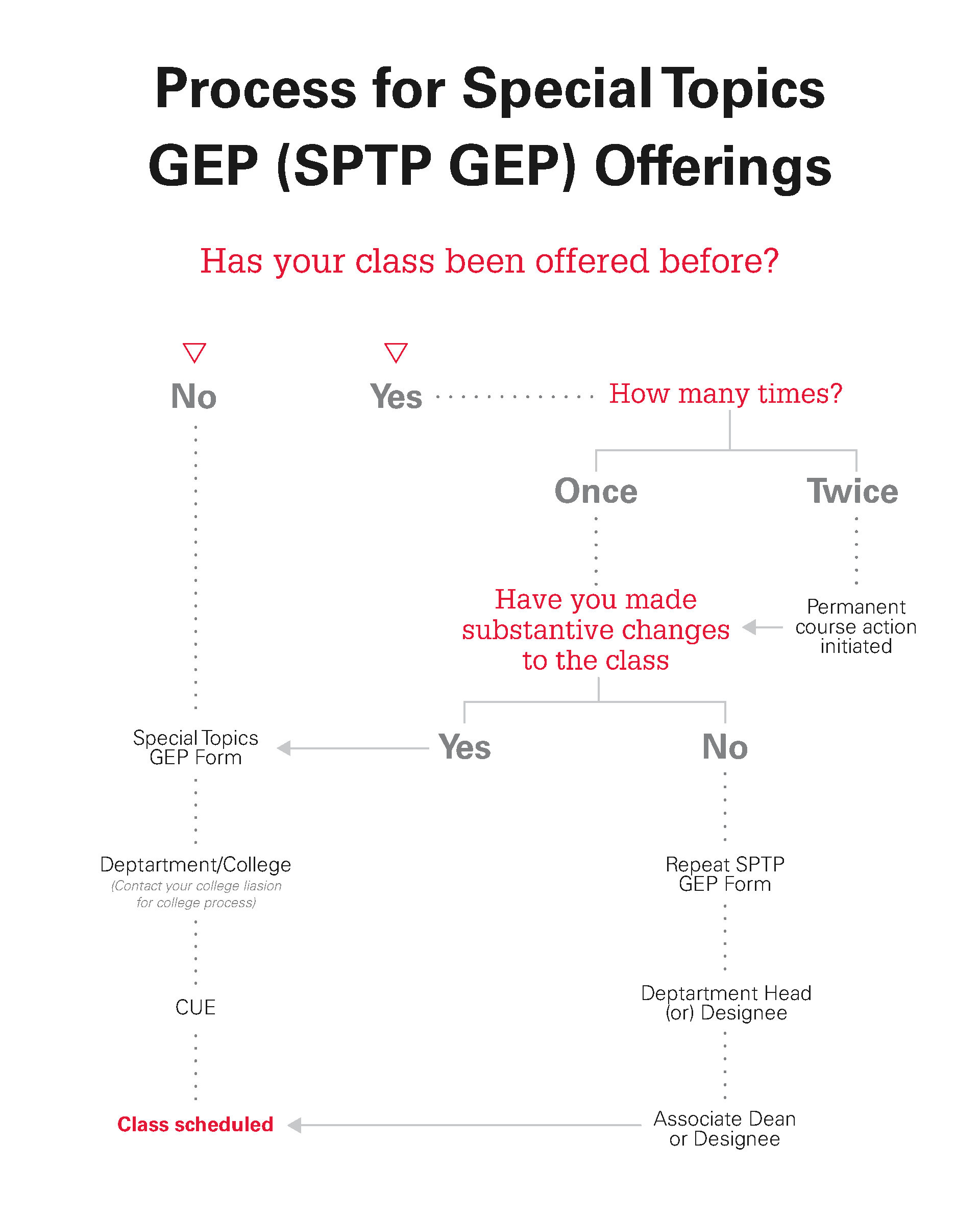
If you are offering it for the first time, you’ll fill out the relevant SPTP GEP form below and the course will run through your departmental/college review as well as CUE review.
If you are offering it for the second or third time and have made substantive changes, you’ll run this through the same departmental/college and CUE review. However, if you are offering the course for the second/third time and have not made substantive changes, you can fill out the Repeat Special Topics GEP form instead and run it through your associate dean/designee prior to OUCCAS scheduling the section.
If no substantive changes have been made to the course after the first approval, the course can run through the Repeat Special Topics GEP Process instead, which includes filling out the Repeat Special Topics GEP Form and review by the Associate Dean or Designee prior to OUCCAS scheduling.
These courses have a maximum of two offerings prior to the course obtaining a permanent number. These offerings must be approved through either CUE or the Associate Dean/Designee before OUCCAS can schedule the section for student enrollment.
To request a special topic that will also satisfy a GEP category/co-requisite for the first time, fully fill out the relevant “Special Topics GEP Form” from the list below and contact your college liaison to begin the approval process.
Please note: These courses must have at least 25% of seats non-restricted (i.e. available to all students) and all fields of the Special Topics GEP form must be filled out in order to be added to a CUE agenda. (“See attachment” or similar will not be moved forward).
Special Topics GEP Forms (First Offerings or Substantive Changes)
Course Prefix/Number Title Credit Hours FAD 295 Foundations of American Democracy Special Topics 1-3 GK 295 Global Knowledge Special Topics 1-3 HES 295 Health & Exercise Studies Special Topics 1-2 HUM 295 Humanities Special Topics 3 HUMG 295 Humanities & Global Knowledge Special Topics 3 IPGE 295 Interdisciplinary Perspectives Special Topics 1-3 IPGK 295 Interdisciplinary Perspectives & Global Knowledge 1-3 MSGE 295 Mathematical Sciences Special Topics 1-4 NSGE 295 Natural Sciences Special Topics 1-4 NSGK 295 Natural Sciences & Global Knowledge Special Topics 1-4 SSGE 295 Social Sciences Special Topics 3 SSGK 295 Social Sciences & Global Knowledge Special Topics 3 VPGE 295 Visual and Performing Arts Special Topics 3 VPGK 295 Visual and Performing Arts and Global Knowledge Special Topics 3
HON Special Topics Forms
Course Prefix/Number Title Credit Hours HON 293 Honors Special Topics – Interdisciplinary Perspectives/Global Knowledge 3 HON 294 Honors Special Topics-Humanities 3 HON 295 HON 295 : Honors Special Topics-Social Science 3 HON 296 HON 296 : Honors Special Topics – Interdisciplinary Perspectives 3 HON 299 Honors Special Topics – Visual and Performing Arts 3
Special Topics Change in Grading Method
The instructor for a special topics offering may request to have the approved grading method changed for the course offering on a per-semester basis. Please note that the grading method must be one of the ones included in the catalog entry for the course (ex: OPT course selecting S/U only). Adding grading methods to a course that is not represented in the catalog also requires initiation of the course action form in CIM for the course prior to approval.
A Request to Change the Semester Grading Method form must be completed, be signed by the department head and submitted to the Office of Undergraduate Courses and Curricula via email ([email protected]) for processing and approval by the Dean of University College or their designee. Please contact [email protected] for further guidance or questions.
Example 1: ABC 295 has a grading method of Graded/SU listed in CIM Courses and the desired grading method is SU. Instructor should fill out the Request to Change form as described above.
Example 2: ABC 295 has a grading method of SU listed in CIM Courses and the desired grading method is Graded. Instructor should initiate the major change in CIM Courses to change the catalog grading method to Graded/SU and once they have initiated workflow, fill out the Request to Change form as described above.
A request to change the grading method must be submitted each semester the course is offered. A course action should be submitted prior to the offering of a special topics for a third time.
Other Specialized Courses
A number of other courses differ in structure and pedagogy from the single-topic, permanent course number. These include
- A Permanent Course Topic Shell
Permanent courses that share student learning outcomes, but use different content to guide students to those outcomes. - A Special Problems course (SP)
Faculty-supervised academic study in the discipline or field involving two or more students focused around a central theme. - An Independent Study (IND)
A course requiring students to participate in individualized, independent, directed, or guided studies under the supervision of an expert or qualified representative of the field or discipline that cannot be otherwise classified as an Internship, Field Experience, Cooperative Education, Practicum, Recital, Performance, or Ensemble. - An Undergraduate Research (RSC)
Faculty-supervised individual or group research related to a specific interest or academic discipline. - An Internship (INT)
A course requiring students to participate in a partnership, professional employment, work experience, or cooperative education with an entity external to the institution, generally under the supervision of an employee of the given external entity.
See UCCC Recommendations/Guidelines for Specialized Coursework for set-up guidance.